


























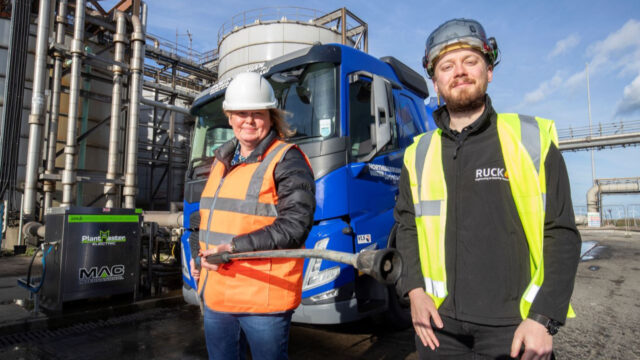
Darlington-based Ruck Engineering has reinforced a 25-year partnership with Northumbrian Water by installing a pioneering zero-emission hot pressure washer system at its Bran Sands treatment works on Teesside.
The new equipment replaces a traditional diesel-heated system and marks a major step in the utility company’s commitment to cleaner, more efficient operations across its North East network.
Ruck Engineering has been supplying industrial cleaning equipment to Northumbrian Water since 1997, supporting sites in Willington, Washington, Consett, Pity Me, Seaham, Howden, Hexham, Durham and many more. More than two dozen bespoke systems have been installed over the decades as part of a trusted and long-standing supply chain relationship.
The new unit, the MAC Plantmaster Electric, is manufactured by MAC International, part of the Ruck Group, at its nearby facilities. It is one of the UK’s first fully electric, zero-emission hot pressure washer systems capable of delivering the same performance and reliability as diesel equivalents.
The installation comes at a strategically important site. Bran Sands is one of Northumbrian Water’s flagship treatment centres, handling wastewater from across Teesside and generating renewable energy from sludge through anaerobic digestion and thermal hydrolysis.
Simon Ruck, Managing Director of Ruck Engineering, said: “Working with Northumbrian Water for more than 25 years is something we’re incredibly proud of. The installation at Bran Sands shows what’s possible when innovation and long-term partnership work hand in hand. We’re helping customers cut emissions without compromising on performance.”
Lyn Coates, Bioresources Logistics Manager at Northumbrian Water, said: “Strong supply chain relationships are essential to how we deliver for customers and communities. By working with local businesses like Ruck Engineering, we’re able to access innovation, support the regional economy and reduce our environmental impact.”
The move reflects a wider trend across the North East, with more companies switching from diesel to electrically powered industrial cleaning systems as sustainability and clean growth remain high on regional and national agendas.