


































The business world is shaped by automation, national delivery networks and online booking systems, so it’s easy to assume that courier services have become fully transactional. Enter a postcode, choose a delivery slot, and wait for a tracking update.
But for many businesses across the North of England, that is not how urgent delivery works in real life.
When a medical item needs to reach a hospital, a replacement part has to keep a production line moving, or an important document must arrive before a deadline, businesses often need more than a faceless delivery platform. They need someone local, reliable and accountable. They need a courier that understands the region, picks up the phone, asks the right questions and treats the delivery as business-critical.
That is why local courier firms continue to play such an important role in the North’s economy.
Logistics is one of the UK’s most important sectors. According to Logistics UK, the industry contributes around £170 billion to the UK economy and employs more than 8% of the national workforce. In the North of England, logistics is especially significant. Research into the Northern Powerhouse economy has estimated that logistics contributes £15.3 billion in Gross Value Added each year, with that figure projected to rise to £20.9 billion by 2039.
Behind those large numbers are thousands of everyday business moments where speed, judgement and trust matter.
A missed delivery is not always a minor inconvenience. For a manufacturer, it can mean delayed production. For a healthcare provider, it can affect the movement of medical supplies or equipment. For a retailer, it can disrupt a store opening or customer promise. For a solicitor, finance team or professional services firm, it can mean a document missing a hard deadline.
In those situations, businesses want certainty.
National parcel networks are ideal for routine consignments, but urgent courier work is different. It is often bespoke, time-sensitive and high pressure. The collection time matters. The route matters. The driver matters. The vehicle type matters. So does the person coordinating the job.
This is where established local operators have an advantage. They know the road networks, trading estates, hospitals, warehouses, business parks and city centre access points. They understand the pressure of moving goods between Leeds, Sheffield, Manchester, Hull, Newcastle, Birmingham, London and beyond. They also understand that when a customer calls about an urgent delivery, the real question is not simply “how much will it cost?” It is “can I trust you to get this done?”
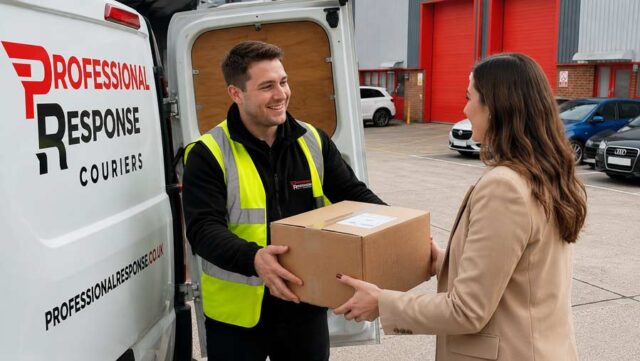
Professional Response Couriers is one example of a Northern business built around that need for trust. Operating from Leeds and Sheffield, the company provides urgent courier and specialist logistics services for organisations across Yorkshire, the wider UK and Europe. Its services include same day delivery, medical delivery, European delivery, temperature-controlled transport, return loads, just-in-time delivery, warehousing and urgent documentation delivery.
For businesses facing tight deadlines, its urgent same day delivery services are designed around time-critical consignments, including documents, parts, equipment and business-critical goods. The business operates 24 hours a day, 365 days a year, giving customers access to support outside standard office hours.
That matters because urgent delivery does not always happen at a convenient time. A part can fail late in the day. A legal document may need to be delivered urgently. A medical or pharmaceutical consignment might require secure, temperature-controlled and careful handling with little room for delay. A retail or fit-out project may need additional stock or equipment at short notice to avoid project delay.
Professional Response Couriers also provides medical courier services for healthcare providers, pharmaceutical businesses, medical institutions and related organisations. This type of delivery requires more than speed. It needs attention to security, traceability, handling requirements and the consequences of failure. For medical and healthcare-related consignments, trust is not a marketing phrase. It is a practical requirement.
The company’s fleet also reflects the variety of work involved in modern courier and logistics support. Professional Response Couriers operates vehicles ranging from small vans for compact urgent items through to large vans, Luton box vans, curtain-sided trucks, tail-lift vehicles, refrigerated vehicles and rigid HGVs up to 18 tonnes. That means customers are not forced into a one-size-fits-all solution. A legal document, a chilled consignment, a palletised load and a bulky piece of equipment all need different handling.
This practical flexibility is one reason local courier firms remain relevant even as logistics becomes more digitised.
Technology has improved the industry. Tracking, route planning, proof of delivery and digital communication all help customers stay informed. But technology alone does not solve every urgent logistics problem. Someone still has to understand the job, select the right vehicle, coordinate collection, manage any complications and make sure the delivery is completed properly.
For Northern businesses, local accountability can be a major advantage. When a courier firm is based in the region, it is not a remote supplier. It is part of the same business ecosystem. Its reputation is built locally, often over many years, through repeat work, referrals and the ability to respond when customers are under pressure.
That kind of relationship is especially important for small and medium-sized businesses. SMEs may not have large logistics departments or national contracts. They need dependable partners they can call when a delivery is too important to leave to chance. Whether they are moving stock, machinery, documentation, samples, equipment or customer orders, they want reassurance that the job is being handled by people who understand the consequences of delay.
The North of England’s economy depends on movement. It’s manufacturing firms, healthcare providers, retailers, construction suppliers, professional services businesses and distribution networks that all rely on goods and documents reaching the right place at the right time. Roads, warehouses and vehicles may form the visible infrastructure, but trust is the invisible infrastructure that keeps urgent delivery working.
That trust is built through reliability. It comes from answering the phone, asking the right questions, giving realistic timeframes, sending the right vehicle and doing what was promised. It is reinforced every time a courier collects when expected, delivers on time and provides proof that the job has been completed.
As supply chains become more complex and customer expectations continue to rise, the role of local courier firms is unlikely to disappear. In fact, for many Northern businesses, their importance may increase.
The future of logistics will continue to involve digital systems, larger networks and smarter technology. But when delivery deadlines really matter, businesses still need human judgement, local knowledge and proven reliability.
That is why companies such as Professional Response Couriers continue to matter. They are not just moving parcels from one place to another. They are helping businesses protect deadlines, keep promises and maintain trust with their own customers.
In urgent logistics, speed is important. But trust is what makes speed valuable.