


































More than half of retailers on Leeds’ high streets are being misrepresented by AI chatbots, with the UK’s three most-used tools returning at least one false fact about 57% of the businesses tested, new research shows.
The study, from AI visibility platform Searchable, put more than 4,300 questions about Leeds shops to ChatGPT, Google’s Gemini, and Perplexity, grading every answer against each retailer’s verified information. This formed part of a wider study of UK retailers involving more than 70,000 prompts of AI search engines across the country.
The AI chatbots returned an answer to a question 98% of the time for queries relating to a retailer’s brand identity, contact details, and location. However, one in 22 answers provided by the AI engines were false.
The most common inaccurate answer misplaced Leeds retailers into the wrong postcode, at a rate of one in 14. This occurred despite the test prompts giving clear identifiers on the city the business was located in and asking the tools to specify the locations of all relevant addresses.
AI chatbots also recommended the wrong website: around one in 21 of the chatbots’ website answers pointed to a dead link, a lookalike, or a different business entirely. In a recurring pattern, where a shop’s trading name did not match its actual web address, the chatbots invented the more obvious domain and pointed customers to a site the retailer does not own.
The tests also show AI chatbots attributed the wrong brand to a shop’s name, at a rate of one in 51 answers.
Searchable co-founder Chris Donnelly explains why this is a challenge for Leeds’ high streets to overcome in reaching new and existing customers: “Overall, our research into this issue has shown that AI inaccuracies are more likely to impact smaller businesses than larger brands across multiple sectors. This can be partly explained by big companies having a larger pool of third-party sources online that provide accurate information about them.
“For a smaller bricks-and-mortar retailer, if their online visibility mostly centres around its website and a Google Business listing, that’s a relatively thin trail of information for AI systems to learn from and to represent in their answers.”
Searchable’s analysis also shows that the levels of misinformation were unevenly distributed across the three Large Language Models (LLMs) tested, with Perplexity returning inaccurate answers about Leeds shops in 8% of cases, compared to 2% for ChatGPT and 3% for Gemini.
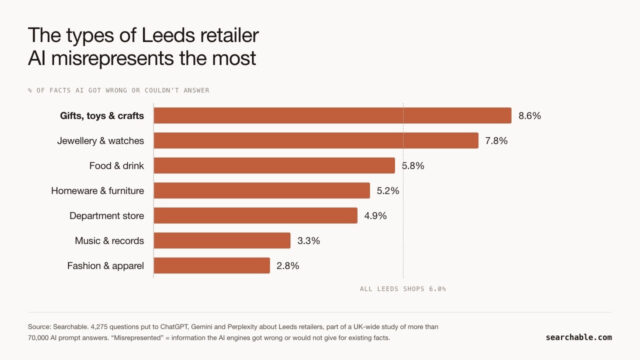
Gift, toys and craft retailers were the most likely to be misrepresented of any type of shop, at a rate of 8.6%.
According to a 2026 Rithium survey of UK and US shoppers who already use AI products, 90% do so for product research and comparison, and 53% have chosen a retailer based on AI suggestions. Inaccurate AI answers risk leading customers astray from high street businesses when these tools are seen as trusted partners in the purchase journey, with 58% of those surveyed also saying they lose trust in a brand when AI provides the wrong product information about them.
Donnelly says that high street retailers can take relatively small steps today to reduce the likelihood of AI systems misrepresenting them: “Ensure your website and third-party business directories are up to date and clearly state your company’s essential services. Beyond that, consider how local press mentions, trade association listings and customer reviews can help you show up more positively and correctly online. These are all factors that influence AI’s interpretation of a brand.”