





















Andy Burnham’s rise to Downing Street this summer feels like the stuff of myth. The Mayor of Greater Manchester, nicknamed the King of the North, is swapping his devolved city region for 10 Downing Street, and his route there ran through a single by-election in Makerfield before he declared for Labour’s leadership. Allies say he will bring a promise of radical devolution to national power, launching his vision for the country from that same Makerfield seat.
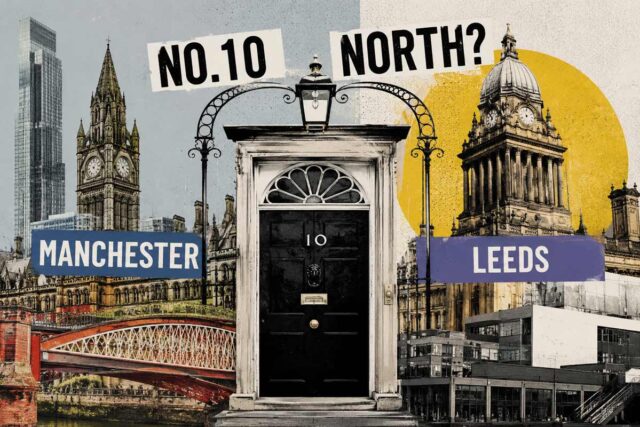
Burnham’s pitch draws on his Manchester record. He calls it Manchesterism: a blend of business-friendly growth, sharp social policy and empowered local government, taken national. He argues Britain is too London-centric, and has coined a Makerfield test to judge future policy by its impact on ordinary people north of Watford. In June he announced the plan in full: a No.10 North branch office in Manchester, coordinating policy with Northern leaders as part of what he calls the biggest rebalancing of power the country has ever seen.
“No.10 North will be the nerve centre of a rewired Britain,” he declared. By carving out a second base for the Prime Minister, Burnham aims to make devolution concrete rather than rhetorical. His speech promised to transfer parts of the PM’s office to the North, housed at the new Manchester Digital Campus, a reclaimed retail site in Ancoats that will eventually host roughly 8,800 civil servants. He has even roped in his own team: the Manchester Combined Authority’s chief executive is set to run No.10 North as his deputy chief of staff.
Andy Burnham speaking after winning the Makerfield by-election in June 2026. He has since outlined plans for a permanent “No.10 North” in Manchester.
Leeds versus Manchester
With the North in the spotlight, the two leading cities have been making their case. Manchester’s pitch is straightforward: it doesn’t need to build anything to get started. There is already office stock in place, including, if needed, decommissioned buildings like the former GCHQ hub, that could house the satellite No.10 at short notice, with more space coming online as the Digital Campus develops. The city also has a major international airport, TransPennine rail links into the rest of the North, and a recently upgraded city centre.
Leeds is making its own case, built on geography and scale. Its pitch rests on a central UK location just off the M1/M62 corridor, and on the size of its economy: the city is home to banks, insurers and government agencies, and sits at the centre of a wider city region of roughly 8.7 million people outside London. Leeds’ mayor argues the city’s success would ripple out across Yorkshire more broadly. On transport, Leeds offers a well-connected station and an international airport serving much of Europe. Its office market is tiny next to London’s, but it is growing fast, with several major developments under way.
London, by contrast, is undeniably well connected, with four airports, three global rail hubs and the densest road network in the country, plus hundreds of millions of square feet of office space and thousands of FTSE and international company headquarters. Staying in London keeps tradition intact and preserves instant access to Parliament and the Treasury, though it sits awkwardly next to Burnham’s devolution message. There is no actual law requiring the Prime Minister to live at No.10, but the building itself, black door and gated forecourt included, is heavily protected as the seat of government, and relocating anything from it would break with centuries of precedent.
| Feature | Leeds | London | Manchester |
|---|---|---|---|
| Geographic centrality | Situated in the North of England; often touted as near England’s ‘population centre’ and the most central UK city. It sits at the junction of M1/M62 (to Midlands and NW). | In the extreme southeast of England; not central geographically but is the historic political capital. | In the North West, well-placed for UK regions except Scotland. Major hub in the Northern Powerhouse. |
| Transport links | Excellent rail (King’s Cross/St Pancras in ~2hrs, and new HS2 links) and motorway (M1/M62). Leeds Bradford airport (European routes). Growing local transit. | Unrivalled: multiple major airports (Heathrow, Gatwick, etc.), all major rail termini (Euston/King’s Cross/Paddington/St Pancras), Underground network. | Strong rail (fast trains to most UK cities, airport with worldwide routes), excellent local tram/rail, and proximity to M6/M62. |
| Office space | Large modern office parks (Arena Quarter, financial centre, old mill conversions). Hundreds of thousands of sq ft added. | Dominant: ~234m sq ft of office stock. Global financial capital with tens of thousands of firms HQ’d here. | Thriving business districts (Spinningfields, MediaCity, Circle Square) with millions of sq ft. Home to tech and media firms. |
| Security infrastructure | Has secure facilities (e.g. West Yorkshire’s police HQ, hospitals) but no dedicated PM-level protection zone. Would need heightened police detail and new secure HQ if PM were nearby. | Heavily secured already (gated Downing Street, armed police, protected airspace). Existing Cobra and MI5 presence. Highest level of protection. | Has police and some Ministry sites (e.g. old GCHQ building). Upgrading to PM-level security (24/7 armed Guard, Air Marshals on flights) would be needed. |
| Symbolic impact | Representing Yorkshire and the North; PM presence would signal shift in power away from Whitehall. Highlights central/northern England. Plus it’s equidistant between Edinburgh and London. | No novelty (status quo); would mean no change in symbolism. Keeping PM in London maintains tradition and avoids perception of favouring regions. | Deep resonance: Burnham’s home turf and Northern powerhouse heart. Sharing Downing Street between Manchester and London would underline a true north-south partnership. |
Reactions from North and South
Northern civic and business leaders have generally welcomed the talk of a Whitehall outpost up north, seeing it as a genuine chance to close the economic gap created by decades of centralisation and to unlock growth that has long been bottled up in London. The union leader Sharon Graham went further, calling Burnham “right on the money” for tackling inequality by devolving power.
Business has reacted positively too, with industry bodies welcoming Burnham’s focus on growth and his plan to use devolution to spread prosperity beyond the capital, and Northern business forums reading it as recognition of the region’s economic weight. Burnham’s speech even won a mild nod from the markets, with UK government bond yields dipping slightly afterwards. Think tanks on both left and right were broadly supportive of the principle, agreeing that more local decision-making could help unstick Britain’s pent-up, London-centric power structure.
Not everyone is convinced. Some Tory MPs and commentators have dismissed a Northern No.10 as a gimmick, or a “second-tier Prime Minister’s Office.” The Conservative leader of Manchester council, a former MP, joked that Burnham could start by painting the famous black door a different colour, though the 18th-century building and its neighbours will not actually be moved. Kemi Badenoch has been more blunt, stating she does not believe in further devolution. In Leeds, some local Tories have pointed out that moving the Prime Minister’s base does not automatically improve local schools, transport or hospitals, and have warned it risks becoming a distraction.
Security experts are raising a practical eyebrow. A retired royal protection officer has dubbed any Northern office “No.10A”, warning it would need full armed guard, round-the-clock surveillance and anti-bomb measures, with an extra fleet of armoured cars and air cover for frequent flights between London and Manchester potentially running to millions in security costs alone. Greater Manchester Police say they are aware of the evolving proposals and would cooperate on the security details. One transport specialist joked that putting the Prime Minister on a fast train twice a week could upset a lot of commuters, eating into the seats normally reserved for armed protection.
Implications for business and the regions
If Burnham’s plan proceeds, Northern businesses could see real benefits. Having the Prime Minister, even part time, based in Manchester or Leeds would signal that government is serious about investing in the North, and regional government offices tend to encourage local universities and start-ups while spurring infrastructure upgrades. CBRE data shows only around 37% of UK offices sit outside London, so new jobs in Leeds or Manchester could genuinely shift investment patterns, and the prospect of projects like extended rail links or tech grants being signed off closer to home has buoyed some investors.
Critics warn of cost and confusion, though. Moving core Whitehall functions, even partially, is complicated. Burnham’s Manchester Digital Campus is still years from completion, not until 2032 according to reporting in the Guardian, so in the meantime his team is looking at interim offices. That dual arrangement raises real questions: will departments split between cities, duplicating support staff? MPs still vote in Westminster, so Burnham will have to travel back and forth constantly, which is an operational headache in itself. Downing Street’s constitutional role means the Prime Minister must remain accountable to Parliament, so the UK is not installing a second legislature in Leeds or Manchester, only offices. Creating No.10 North is, in the end, more a political statement than a logistics exercise.
Still, many in the North hope the symbolism alone will do some good — that ending decades of decision-making concentrated in London might spur more local investment on its own. For Northern business and civic leaders, a Northern No.10 would be a signal that the region is back at the centre of the conversation, not an afterthought.