
























These days, many organisations are facing increasing labour pressure due to staff shortages, rising labour costs and increased operational demand. These pressures are particularly visible in industries such as healthcare, warehousing, manufacturing and large commercial buildings.
However, labour challenges are not always just about the headcount, but also how staff time is actually being used. Automation is now becoming an effective solution as it is not about replacing people but improving efficiency and reducing unnecessary workloads.
In this article, the team here at Aerocom, suppliers of AGV solutions explores where labour pressure comes from and how intelligent automation can be used to reduce it. This includes looking at practical technologies such as AGVs, pneumatic systems and building automation.
Where labour pressure really comes from
Labour pressure is often driven by repetitive low value tasks, manual handling and transport, and inefficient workflows. This means that staff are moving items between departments and spending their time walking around the business instead of working in it.
They are also often left waiting for materials or information to arrive. Highly skilled staff are therefore often doing tasks that do not require level of skill. This results in reduced productivity, increased fatigue and lower job satisfaction.
The hidden cost of manual processes
For businesses, these manual processes create delays, inconsistency and higher error rates. It is important to remember that labour costs are not just related to wages but also wasted time and inefficiency. When there are small inefficiencies that are repeated across teams, they can become significant. This could include repeated trips across a building or the manual delivery of documents or materials.
All of this combines to create slower operations, increased operational costs and pressure on already stretched teams, which businesses are struggling to deal with.
What is intelligent automation in a building context?
Intelligent automation refers to the systems that reduce or remove manual intervention in routine processes. In buildings, this includes automated transport systems, smart building controls and workflow integration, among other things.
It is important to remember that automation does not just mean robotics, as it can also include support systems that improve how work flows through a building. Automation is designed to support people rather than replace them.
How automation reduces labour pressure
Automation is very successful at removing repetitive tasks. It can take over things like transport and handling, and routine processes so that staff can focus on skilled work and decision-making tasks. It can also improve workflow efficiency through the faster movement of items and information. This helps to reduce waiting times between departments and provide small, consistent processes.
It can also reduce the physical strain of employees as there will be less manual handling that needs to be done. It has been shown to reduce the risk of injury, which is particularly relevant in healthcare, warehousing and industrial environments.
Automation is also extremely useful in supporting workforce shortages. It can fill operational gaps and allow teams to operate effectively with fewer resources, therefore reducing any reliance on additional hires.
Key technologies supporting intelligent automation
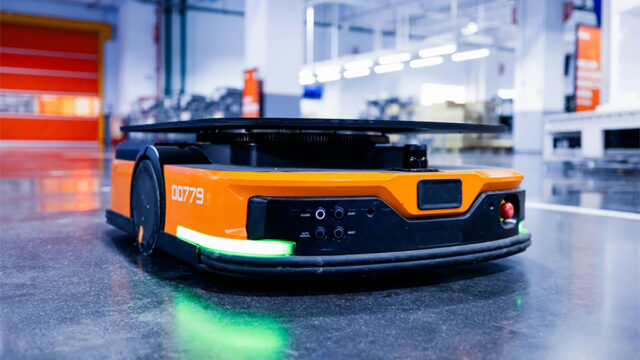
Automated guided vehicles (AGVs) are driverless vehicles that transport goods within a building and are an effective part of automation. They follow predefined routes or use sensors for navigation around warehouses, hospitals and manufacturing facilities.
They can move materials, equipment and supplies, therefore reducing manual transport tasks and improving consistency and reliability thanks to their ability to operate continuously without the need to consider break times or shift patterns.
Pneumatic tube systems are also extremely effective within a variety of different settings. They are systems of tubes that can transport small items such as documents, samples and small parts from one place to another in a matter of seconds using nothing more than air pressure.
This allows for instant delivery between departments without the use of any staff members and can therefore eliminate walking and delays. It is also extremely effective at reducing human error and handling. These types of systems are often found in hospitals, offices and industrial sites.
Building automation systems provide control systems for things like HVAC, lighting, and energy usage. Whilst these do not directly handle labour transport, they can reduce operational workload as they ease the need for manual intervention, optimise energy and environment and improve operational control.
Real world impact, efficiency, cost and productivity
Intelligent automation can lead to reduced labour costs through efficiency rather than cuts. It also offers faster operational throughput and more predictable workflows. This means that staff time can be redirected to higher value tasks, making them much more effective.
Many businesses are benefiting from the use of automation. They are not only experiencing improved service delivery but also reduced delays and a better use of resources, making automation an investment in operational performance.
Where to start with automation?
In order for automation to be successful within a business, it is important to identify the bottlenecks that you are experiencing. It is important to look at where delays are happening and where staff are spending time on repetitive tasks. This allows a business to then focus on high frequency processes and high traffic areas.
Bringing automation into a business might sound like a huge task, but it is possible to start small by looking at a single department or workflow and choosing appropriate solutions, such as AGVs when larger transport is needed, or pneumatic systems for fast, small-item delivery. This kind of incremental improvement is much easier to bring into a business and can prove to be extremely effective.
It can be easy to think that labour pressure is simply a staffing issue, but it actually relates more closely to efficiency. Manual processes create their own hidden costs whilst automation is able to remove unnecessary workloads.
Technologies such as AGVs and pneumatic tube systems can provide practical solutions for a range of different businesses. It allows organisations to improve their productivity, reduce the pressure on staff members and operate more efficiently all at the same time. The businesses who are adopting automation are now better positioned to manage their future workforce challenges.